|
PRODUCTS
Thermaboard
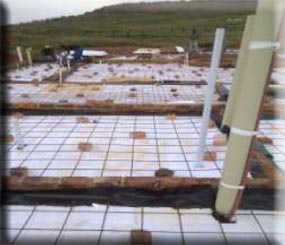
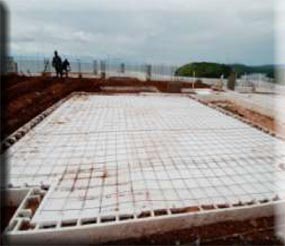
Thermoboard being installed for under
concrete ground floor insulation
-
THERMOBOARD
is a 40mm
thick expanded polystyrene
(EPS)
sheet
that is primarily used for thermally
insulating concrete ground floor slabs.
The standard dimension of the
THERMOBOARD
sheets is
1200 x 1200 mm.
-
The sheet edges re
tongue and grooved so that they tight fit
together and prevent any thermal bridging.
-
When fitting the
THERMOBOARD
sheets
that they may be glued together using a quick
setting
EPS
adhesive such as
EBS’s POLYGLUE.
-
Steel mesh used in
the concrete slab itself can be spaced off the
THERMOBOARD
sheets with
EBS’s
high density
EPS
mesh spacers.
-
THERMOBOARD
can also be used in brick cavity walls and above
conventional ceiling boards to thermally
insulate these areas.
-
THERMOBOARD
is particularly useful in optimising the
performance of under floor heating systems as it
stops heat generated form dissipating into the
ground.
-
As
EPS is
impervious to water
THERMOBOARD
also acts as a moisture penetration barrier.
Download
THERMOBOARD
 data sheet - click here
 |
|
|
THERMOPOUR
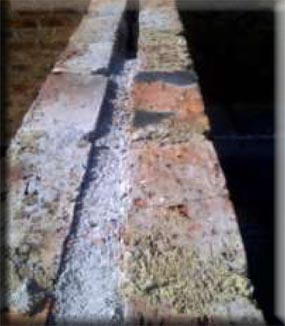
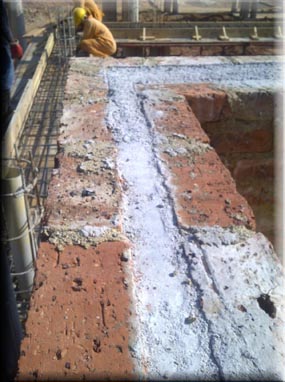
Thermopour being used to fill and
insulate cavity brick walls.
|
THERMOPOUR
is a dry, lightweight, volcanic glass which
is mixed with cement and water to make a
pourable slurry which once applied dries to
form a thermally insulating barrier in a
range of construction applications.
THERMOPOUR
can be used in the following applications:
-
Brick wall
cavity insulating filler.
-
Insulation
of concrete roof decks.
-
Under
concrete floor insulation
-
Build up
screed on concrete floors to provide
improved insulation.
-
Insulating
plaster on conventional brick and
concrete walls.
Depending on the
mix ratio used
THERMOPOUR
can have ultimate strengths ranging from 1,5
-15 MPa.
THERMOPOUR
has the following advantages:
-
Lightweight
and easy to transport and mix.
-
Compatible
with Portland cement.
-
Excellent
fire resistance and if used in the
applications above will improve the
overall fire resistance of buildings.
Resists spalling during fires.
-
Superior
strength to lightweight concretes as
does not rely on air entrapment.
-
Low water
permeability which helps stop the
ingress of water and moisture into
buildings.
· Good
adhesion to brick and cement. When used as
an insulating filler in cavity walls
THERMOPOUR
increases the overall strength of cavity
walls by binding the two brick skins
together and by the residual strength of the
product itself.
THERMOPOUR
mixing instructions are contained in the
THERMOPOUR
data sheet.
THERMOPOUR
is supplied in 10kg/100lt bags.
Download
THERMOPOUR
data sheet -
click here |
|
|
EBS
POLYBLOCK
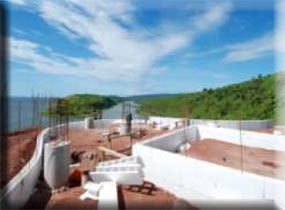
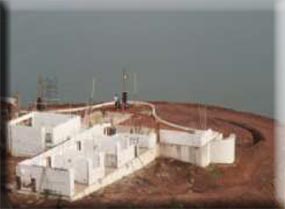
EBS Polyblock house under construction in the DRC.
|
EBS
POLYBLOCK
is an
EPS
insulated concrete form walling system (ICF).
ICF's have been used extensively worldwide
for close to 50 years to construct quick to
build, thermally insulated buildings.
EBS
POLYBLOCK
is a hollow EPS building block 1200mm long x
300mm high x 120/150/180mm wide that is
filled with concrete and reinforcing steel
to build structural walls and is plastered
using
EBS’s EPS
plaster system
POLYPLAST.
EBS
POLYBLOCK
can be used for:
-
All
types of residential construction.
-
Public
buildings
-
Perimeter
walls
-
Agricultural
buildings
-
Infill
panels for steel frame construction.
-
High
rise developments as partition walling.
The prime
benefits of using
EBS POLYBLOCK
are:
-
Permanent thermal
insulation.
-
Lightweight and quick and
easy to build accurately.
-
Limited requirement for
skilled labour.
-
Cost competitive vs.
other construction methods.
-
Structurally sound being
2-3 times stronger than conventional
brickwork.
EBS
POLYBLOCK is
Agrément
approved and thus complies with the South
Africa building codes and is thus accepted
by the banks and municipalities.
EBS POLYBLOCK
as a thermally insulating building system
assists in meeting the “Energy Efficiency in
Building” requirements laid down in the SANS
204/XSA10400 codes of practice.
Download
EBS POLYBLOCK
data sheet -
click here |
|
|
TASS
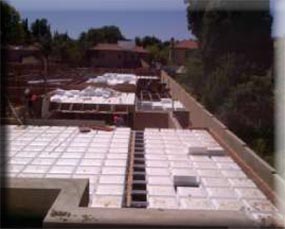
TASS being installed in residential and commercial
buildings.
-
TASS
is an abbreviation for ‘Thermal
Acoustic Slab System’.
-
TASS
is a combination of moulded
EPS
‘coffer’ blocks and high tensile,
galvanised steel cold rolled channels
that act as the support ribs for the
EPS
blocks in the
TASS
suspended floor and roof slab system.
-
TASS
acts as a permanent coffer system to
support the reinforced concrete element
of the slab.
-
By using
EPS
blocks in the system
TASS
provides excellent thermal insulation to
buildings.
-
Other
advantages include:
-
TASS
components are lightweight and quick and
easy to install with reduced labour
requirement.
Improved sound insulation.
-
Fire performance
equivalent to all concrete slabsystems.
-
Fully load
bearing.
-
The
TASS
system comprises 4 different block depths
allowing deeper beams to be formed enabling
‘free’ spans of up to 12 metres.
-
The combination
of
TASS
blocks allows beams to be incorporated into
the slab depth eliminating the need for down
stand beams.
-
The system is
dual spanning
TASS was
commercially introduced to the South African
market in 2003 and its acceptance has grown
continually through a wide range of projects in
South and central Africa.
As a thermally insulating system
TASS assists
in buildings meeting the SANS204/XSA10400
“Energy Efficiency in Buildings” codes of
practice.
TASS is fully
supported by and in house engineering design
service and quotations are supplied within 24
hours from email submission of plans to:
info@mrhce.co.za.
Download
TASS
data sheet - click
here |
|
|
POLYPLAST
|
POLYPLAST is
a plaster system specifically designed for
EPS building
systems and is recommended for use with the
EBS POLYBLOCK
walling system and for
TASS ceiling
soffits.
POLYPLAST is
a combination of water based acrylic resins
which is mixed with plaster sand and water to
form a workable, easy to apply plaster mix.
The advantages of
POLYPLAST
are:
-
Excellent
adhesion to
EPS.
-
Does not shrink crack and as the product
remains flexible does not crack over time.
-
Takes on the colour appearance of the
plaster sand used and can be left with this
‘natural’ appearance or painted.
-
Can be used to repair cracked or damaged
plasters on brickwork.
POLYPLAST
application thickness is recommended at 6-8mm
and at this thickness is cost competitive with
conventional plasters at 15-20mm thickness.
Download
POLYPLAST
data sheet - click
here |
|
|
EBS POLYJOINT
|
EBS POLYJOINT
is a range of pre-cut sheets of
EPS 100mm
thick x 1,200m long at varying heights – 170mm,
255mm and 340mm to suit different concrete slab
depths.
EBS POLYJOINT
is used for expansion joints in concrete to
replace soft board often used in this
application. Soft board has the disadvantages of
swelling when in contact with water and
deteriorating over time.
EBS
POLYJOINT
overcomes these problems by being dimensionally
stable, impervious to water, easy to cut and
place, long lasting and lightweight.
Download
EBS
POLYJOINT
data sheet - click
here |
|
|
POLYGLUE
|
POLYGLUE is a
synthetic rubber based adhesive used to bond
EPS
to itself and to all other clean and dry
surfaces such as metal, brick, wood and
fibreglass.
POLYGLUE
functions as a contact adhesive and has the
following advantages:
POLYGLUE
is available in 1 and 5 lt. standard pack sizes.
Download
POLYGLUE
data sheet - click
here |
|









 Fax:
011 822 5272
Fax:
011 822 5272